Demining Ukraine: The Challenge and the Breakthroughs Ahead
According to the World Bank, Ukraine will need $37 billion to clear its land of mines. The Washington Post, citing global experience, warns it could take 750 years to complete this task under traditional approaches.
But time, cost, and safety are challenges that Ukraine is already addressing head-on. The Ukrainian Association for Humanitarian Demining and Recovery (UAHDR) is uniting key players, sharing expertise, and deploying cutting-edge technologies. The result? Hundreds of hectares of safe land already returned to communities.
Croatia: 4 Years of War, 30 Years of Demining
Croatia’s experience highlights the stakes. Nearly three decades after its conflict, the country is only now nearing the end of mine clearance. It’s a cautionary tale: the path to safe land is long unless the right scenario and tools are in place early.
Ukraine’s Unique Demining Landscape
Ukraine faces an unprecedented challenge: 139,000 km² of potentially mined land, including:
- De-occupied territories,
- Active combat zones,
- Occupied areas.
In liberated zones, a land exclusion list can be applied — areas are removed from the contamination register if no explosives are found. Encouragingly, global data suggests only about 15% of inspected land ends up contaminated.
However, no country has ever dealt with such a density and variety of explosive threats. From factory-produced anti-tank and anti-personnel mines to improvised and modified devices, sappers have already identified over 2,500 types of explosive ordnance — compared to 1,000 cataloged before the war.
To address this, Ukraine needs a fundamentally new approach: not just for detection, but for building databases to train AI models. We need tens of thousands of images — from multiple angles, conditions, and spectra — to enable smart detection.
Non-Technical Survey: The Critical First Step
According to national standards, humanitarian demining starts with a non-technical survey: interviews with locals, analysis of combat logs, and minefield maps. But amid a full-scale war, these sources are often unavailable, unreliable, or deliberately falsified.
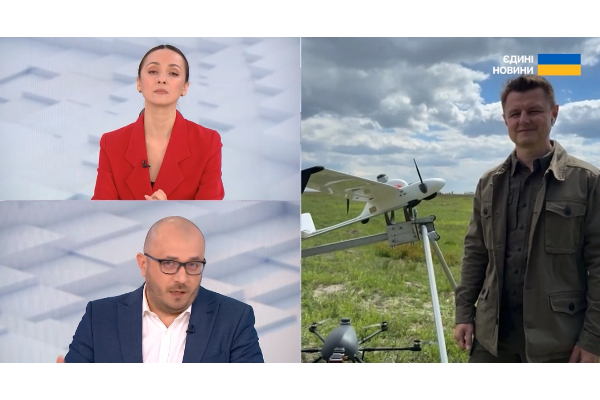
Today, UAVs offer a more accurate and efficient alternative. UAHDR member DEF-C uses multi-rotor systems (Beetle) and fixed-wing aircraft (CETUS) to survey large areas — often exceeding 150 hectares. These UAVs are equipped with visible spectrum, multispectral, and thermal cameras, capturing millions of images per flight.
IRIZI Demining Maps: A Ukrainian Innovation
This data is processed using IRIZI Demining, a platform developed by Ukrainian engineers. The software:
- Builds high-resolution orthophotomaps and 3D terrain models;
- Validates threat images manually or via AI;
- Codifies threats and geolocates them precisely;
- Integrates with mine action workflows to optimize demining plans, assign teams, and track real-time progress.
IRIZI and domestic UAV systems are already in use across Mykolaiv, Kharkiv, and Kherson.
A Growing Ecosystem and New Opportunities
Ukraine now has over 70 mine action operators. With legislative support — such as recent laws enabling preferential imports for equipment — five domestic production facilities for demining tools have already launched.
Modern UAVs and AI are already replacing outdated demining steps, but Ukraine must scale faster. The UAHDR is in talks with U.S. partners offering technology capable of subsurface scanning up to 60 cm deep. Such tools could dramatically enhance safety and reduce risk to human deminers.
Ultimately, the most dangerous work must be robotic, with humans in control, not in danger.
A New Global Standard Is Emerging in Ukraine
Ukraine is forging a new global standard for mine action — blending lessons from past conflicts with cutting-edge technologies and a bold, data-driven approach.
By combining artificial intelligence with human expertise, and through collaboration across sectors and borders, Ukraine is finding the optimal formula for progress.
The more stakeholders join this mission — testing ideas, sharing lessons, and pushing innovation — the faster we move toward a shared goal:
A safe, mine-free Ukraine.
Based on the interview with Andriy Savarets, Coordinator of the Ukrainian Association for Humanitarian Demining and Recovery, on the “United News” telethon (1+1 Channel).